OFF-CYCLE RESEARCH / TRANSITION MAP · v1.0.0
AGI is not the finish line. It is the start of a compounding race.
Google DeepMind’s “From AGI to ASI” replaces one magical takeoff story with four pathways and six frictions. For the fund, that changes the object of observation: not a date, but the path × friction × economic transmission × listed owner × price chain.
OOP-AGI-TO-ASI-PATHWAYS-2026-09-15 · 57 PAGES · SHA256 c1abb9739243…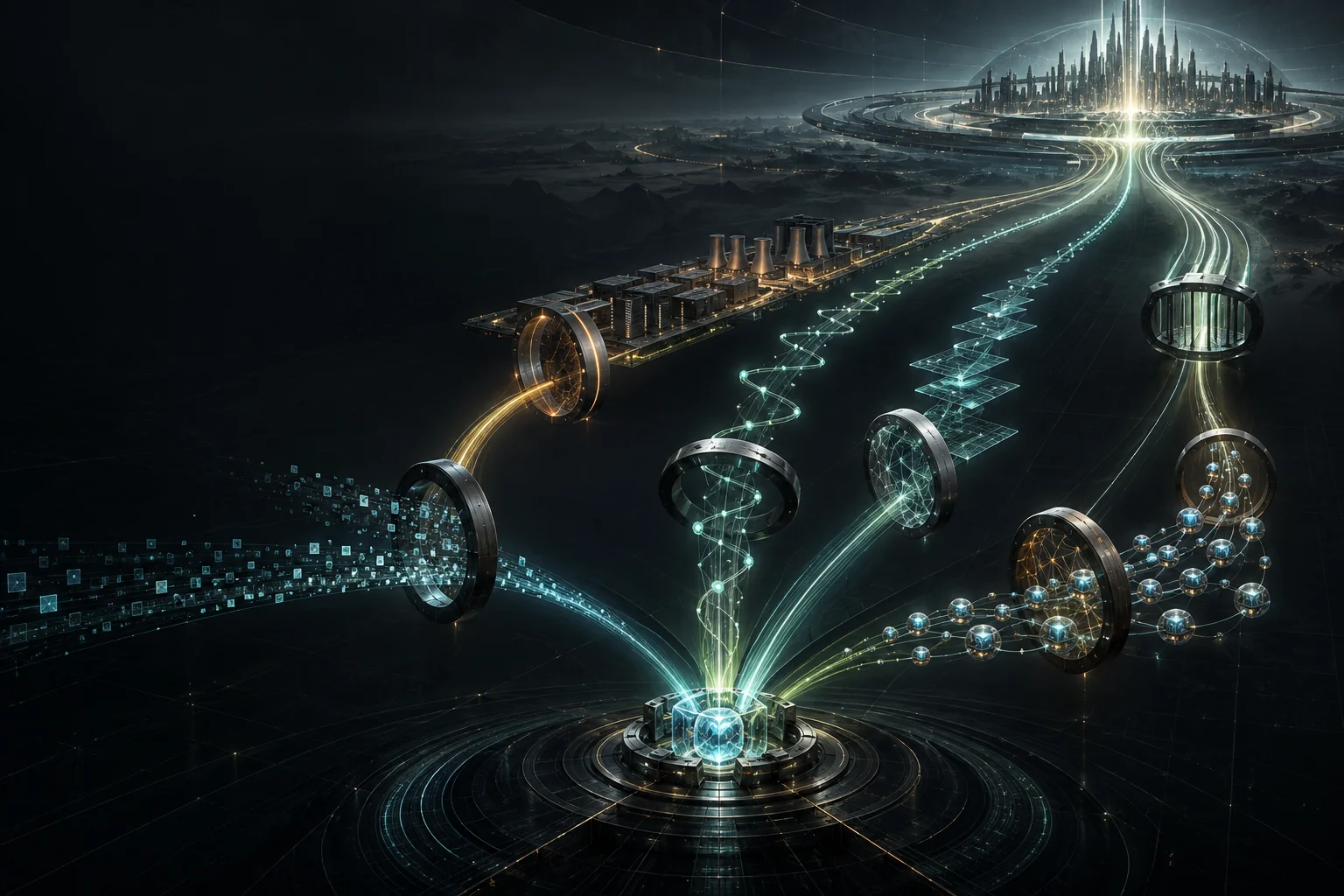
We admit the paper as a transition ontology, not a timetable or a buy list. Its strongest investable insight is that the decisive discontinuity may be organizational: cheap, lossless copies of competent AGI coordinating at machine bandwidth can create a superhuman system before any single model looks like a solitary superintelligence. The opportunity may therefore emerge before formal ASI—and the bottleneck rent may migrate between models, compute, memory, networking, power, experiments and orchestration as each friction tightens.
01 / DEFINITIONS
Three levels—not one slogan
Artificial General Intelligence
Competent AGI: performance around the median skilled human across most cognitive tasks—not perfection, omniscience or universal autonomy.
Artificial Superintelligence
Generally superhuman intelligence that outperforms large, well-coordinated groups of thousands or tens of thousands of expert humans across virtually all cognitive domains.
Universal AI
An idealized, generally incomputable upper-bound concept such as AIXI. It is a theoretical landmark, not the operating definition for the portfolio.
02 / DIGITAL COMPOUNDING
Why digital intelligence can compound
Faster input and output
Machine interfaces can ingest and emit information far faster than human reading, typing or speech.
Faster internal processing
Reasoning cycles can compress when hardware, architecture and inference systems improve.
Memory capacity
Digital systems can retain, search and combine far more working context and exact experience.
Substrate independence
Software intelligence can move across machines and be paired with specialized compute and tools.
Lossless replication
A capable system can be copied without the long training cycle required to reproduce a human expert.
High-bandwidth sharing
Copies can exchange learning and state more directly than human organizations can.
03 / PATHWAYS
Four paths that may run in parallel
Scale compute, models and data
More effective compute expands capability without requiring a new scientific paradigm.
- WATCH
- Training and inference compute; algorithmic efficiency; memory bandwidth; power; data-center lead time; useful-task cost.
- CAPITAL
- Semicap, networking, memory, power and data-center owners may capture scarcity rent—but only if utilization and owner cash outrun capex and priced expectations.
Algorithmic paradigm shift
A new architecture, learning rule or search method breaks through a plateau.
- WATCH
- Capability per unit of compute, transfer to unfamiliar tasks, data efficiency, reproducibility and migration cost.
- CAPITAL
- Architectural optionality matters: a breakthrough may raise frontier labs while stranding model, accelerator or data-center assumptions optimized for the old stack.
Recursive research improvement
AI increases the rate or quality of AI R&D, which improves the next system and repeats the loop.
- WATCH
- Accepted end-to-end R&D outputs, intervention rate, experiment throughput, time-to-result, replication and compute-adjusted gain.
- CAPITAL
- This is the most convex path, but demos are insufficient. Value depends on reliable accepted research and on whether physical experiment cycles can keep up.
Multi-agent collective
Many AGI-level agents specialize, coordinate and share experience until the group outperforms any human organization.
- WATCH
- Group output versus the best single agent, coordination overhead, communication bandwidth, fault propagation, security and cost.
- CAPITAL
- Orchestration, identity, observability, networking and memory can become the control points. The model layer may commoditize while system-level demand explodes.
04 / COUNTERFORCES
Six forces that can slow the race
Data wall
Synthetic, interactive or embodied data fails to sustain capability gain after contamination and quality controls.
Resource and economic wall
Compute, energy, memory, cooling, capital or supply lead times grow faster than useful output and cash capture.
Current paradigm is insufficient
Scaling delivers narrower benchmark gains but persistent failures on generalization, planning, agency or reliability.
Research gets harder
Marginal discoveries require more compute, experiments, researchers or elapsed time for less accepted progress.
Abstraction and physical latency
The system cannot observe or manipulate the real variables needed, while labs, fabs, grids and experiments retain real-time clocks.
Deliberate slowdown
Regulation, safety controls, export rules, litigation or social resistance constrain deployment and replication.
05 / TRIANGULATION
What current evidence says
frontier training compute
Epoch AI’s current trend—not the paper’s illustrative compounded 10× effective-compute history.
open source ↗pretraining algorithmic efficiency
A separate lever from hardware and spending; it must not be counted twice.
open source ↗gigawatt data-center build time
A reminder that intelligence can copy faster than grids and buildings can.
open source ↗agents inside real AI-company workflows
Autonomy is emerging, but METR found judgment and reliability still materially below human colleagues.
open source ↗illustrative >99% AI-R&D automation model
Not a forecast adopted by the fund: METR explicitly highlights measurement and task-translation uncertainty.
open source ↗06 / ALPHA TRANSLATION
What this means for AGI capital
- 01
The transition should be modeled as a sequence of regime changes, not one binary AGI date. Capabilities, organizational scale, diffusion, physical supply and owner cash can move years apart.
- 02
The fastest capability path may not create the best security. Returns accrue to the owner of the scarce complementary asset after capex, dilution, regulation and competition.
- 03
A plateau at exactly human level is an unstable base case, but pre-AGI plateaus and uneven domains remain plausible. We need evidence on each path and friction, not confidence rhetoric.
- 04
Physical clocks create both hedge and exposure. Power, chips, memory and networks benefit only while they remain scarce and architecture-compatible; abundance or paradigm change can reverse the rent.
- 05
The fund’s unfair advantage must be the longitudinal record: which path advanced, which friction moved, which owner captured economics and what price expected before the evidence arrived.
07 / FORWARD OBSERVER
The new tracking contract
PATH × FRICTION × TRANSMISSION × OWNER × PRICE
pathIdfrictionIdcounterEvidencecapabilityReceiptphysicalReceiptownerEconomicsReceiptpriceReceipthorizonfalsifier08 / PRE-COMMITMENT
When the observer may open a review
Scaling regime changed
A comparable trend break plus a primary supply, cost, utilization or lead-time receipt opens research review.
AI R&D loop strengthened
A repeated, independently inspectable, accepted end-to-end R&D result must reduce elapsed time or cost with disclosed interventions.
Collective advantage demonstrated
A multi-agent system must beat the best single agent on repeated unfamiliar tasks after coordination cost and failure propagation.
Physical constraint repriced
Measured power, memory, networking, fabrication, data-center or experiment latency must change the causal bottleneck.
Capability reached owner economics
Only causal revenue, gross-profit or free-cash evidence plus a point-in-time expectation gap can open issuer review.
09 / SOURCE CONTROL
Evidence ledger
Canonical record for the 57-page source document, definitions, six digital advantages, four pathways and six frictions.
arxiv.org ↗PRIMARY · LAB PUBLICATIONGoogle DeepMind · From AGI to ASIInstitutional publication record and author attribution.
deepmind.google ↗PRIMARY · LIVE MEASUREMENTEpoch AI · AI TrendsCurrent compute, efficiency, cost and data-center indicators used to triangulate the paper’s scaling pathway.
epoch.ai ↗PRIMARY · FIELD EVIDENCEMETR · Frontier Risk ReportObserved AI agents in real R&D workflows, including the gap between emerging autonomy and human judgment/reliability.
metr.org ↗PRIMARY · MODEL WITH CAVEATSMETR · A simpler AI timelines modelA transparent automation model used as a sensitivity check, not as the fund’s adopted calendar forecast.
metr.org ↗