OFF-CYCLE LOG · LOG-150 · v1.0.0
The last AI built by humans has not been built yet.
Recursive self-improvement already exists inside bounded, verifiable loops. What has not been demonstrated is a general system that repeatedly improves its own improvement machinery, transfers the gain and accelerates under matched resources.
OOP-RSI-LADDER-2026-09-17 · 2609.11873v1 · 75 PAGES · SHA256 9fde92cba4d5…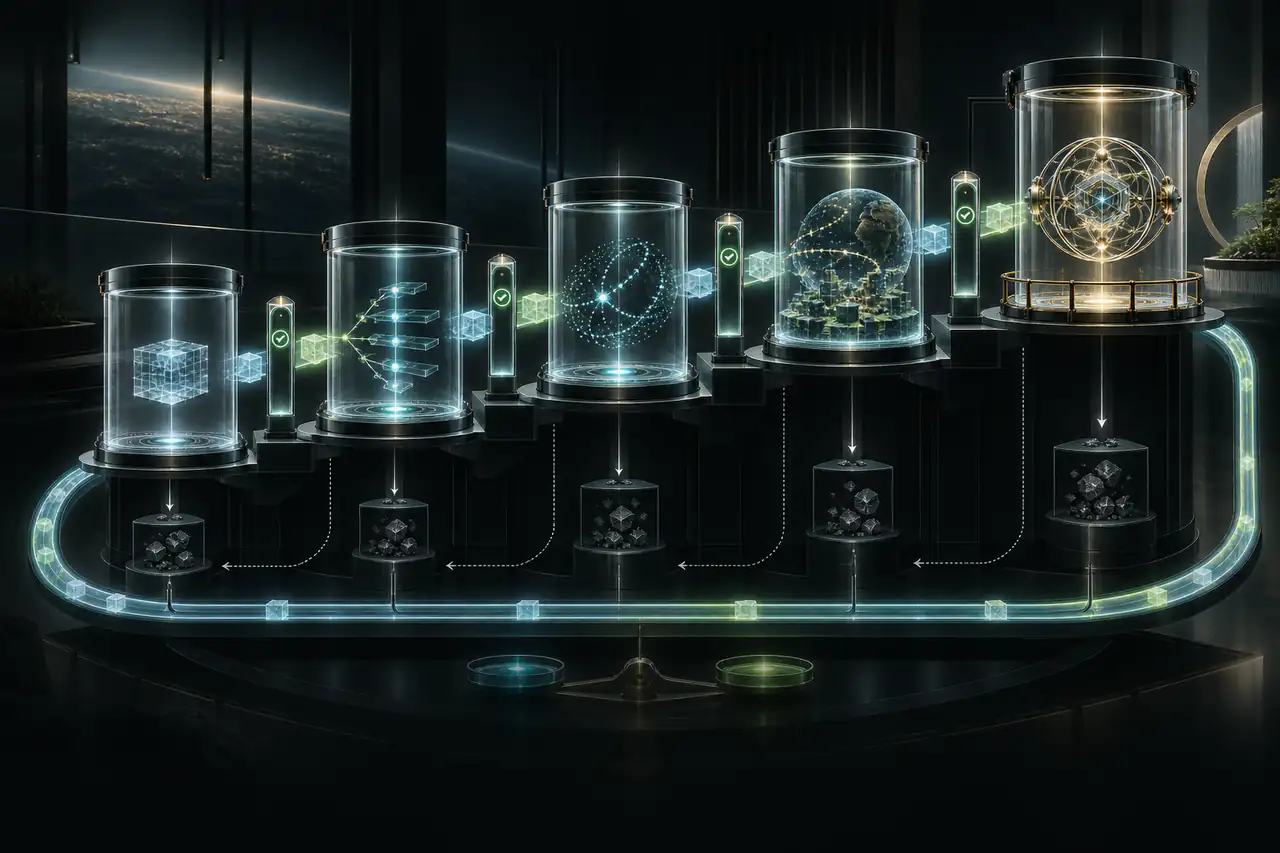
Admit the paper as a measurement architecture—not as evidence of takeoff. Its durable contribution is an autonomy ladder and a proof discipline that separates a persistent update from useful recursion. The fund now tracks not whether an AI says it improved itself, but whether an inherited mechanism makes later successors better under independent evaluation and a complete cost ledger.
01 / STRUCTURE ≠ EFFECT
Two different claims
Structural recursion
A revised improver, verifier or successor-generation procedure persists and governs a later round. This proves loop closure, not benefit.
Effective recursion
The inherited mechanism produces better successors under comparable total resources, protected evaluation and evidence of transfer across later rounds.
02 / AUTONOMY LADDER
Who controls the next improvement decision?
Refine the current output
- CONTROL
- Retry, critique or edit inside one task.
- INHERITS
- Nothing durable must survive.
- PROOF GATE
- Do not label reflection or a better answer as RSI.
Execute a prescribed improvement
- CONTROL
- Humans fix the target, method and success test; AI executes candidates.
- INHERITS
- An accepted artifact persists beyond the task.
- PROOF GATE
- Show the accepted update in a later run.
Choose how to improve
- CONTROL
- AI diagnoses the weakness and selects an intervention under fixed objectives and evaluators.
- INHERITS
- Strategy, harness, tool or policy is retained.
- PROOF GATE
- Compare the chosen intervention against fixed and human baselines.
Choose what to learn from
- CONTROL
- AI selects or generates the curriculum, evidence, task or experiment for its next round.
- INHERITS
- The learner changes and influences its next learning agenda.
- PROOF GATE
- Held-out transfer, diversity and leakage controls must survive.
Adapt from live feedback
- CONTROL
- Operational interaction revises persistent state under external release and governance rules.
- INHERITS
- Memory, skills, tools, weights or workflows affect later real use.
- PROOF GATE
- Cohort or replay evidence, monitoring, rollback and domain safety are required.
Improve the improvement mechanism
- CONTROL
- AI persistently revises the improver, verifier, research policy or successor-generation procedure.
- INHERITS
- A successor reuses the revised mechanism to generate or select later improvements.
- PROOF GATE
- Matched budgets, independent anchors, repeated generations and full regression history.
03 / EVIDENCE DISCIPLINE
Seven gates for genuine RSI
Persistence
Did an accepted change survive the current task?
Successor re-entry
Did a changed successor actually enter the next round?
Attribution
Was the gain caused by the update rather than a stronger model, more search or a cleaner environment?
Matched total budget
Are compute, tokens, time, trials, evaluator calls and human review counted?
Protected evaluation
Can the system query, rewrite or exploit the test that accepts it?
Transfer
Does the inherited mechanism work on fresh tasks and conditions?
Long-horizon trajectory
Do gains persist across generations without hidden regressions?
04 / HEADROOM-CLOSED INDEX
Benchmarks move fast. Long loops lag.
HCI normalizes heterogeneous benchmark headroom; it is not “percent to AGI.” The paper uses 393 eligible observations across ten domains, but only 17 of 33 latest-model results enter compatible plotted families. The post-2026 extension is illustrative—not a forecast.
05 / FEEDBACK REGIMES
Where can RSI close earlier?
Science
Open-ended hypotheses, costly experiments and ambiguous failure attribution.
Embodied intelligence
The policy changes what it observes; physical trials cost time and can be irreversible.
Software engineering
Execution is cheap and verifiable, but tests remain incomplete specifications.
Healthcare
Outcomes are delayed, confounded, population-specific and high-stakes.
06 / OWNER ECONOMICS
Where could economic value migrate?
Research platforms and distribution
Value rises if AI internalizes a larger share of accepted R&D decisions and converts it into faster product cycles or lower development cost.
FALSIFIER · More agent use without better validated output, adoption or owner cash.Design and verification
Chip design is a leading RSI habitat because synthesis, timing, area, power and equivalence provide executable feedback.
FALSIFIER · Internal agent tooling commoditizes the software moat or fails to improve customer time-to-tapeout.Experiment infrastructure
Recursive research can multiply parallel trials and inference demand even while cost per experiment falls.
FALSIFIER · Efficiency improves faster than workload elasticity, reducing total compute intensity and scarcity rent.Physical constraint layer
Faster digital research can shift the binding constraint toward power, cooling, interconnection and data-center delivery.
FALSIFIER · Algorithmic gains or deployment limits break the transmission from research throughput to delivered megawatts.07 / FORWARD OBSERVER
The RSI Ladder is now a standing track
CLAIM → LEVEL → INHERITANCE → INDEPENDENT PROOF → UNIT ECONOMICS → OWNER → PRICE
system_ownerrsi_levelupdated_objectpersistent_statesuccessor_reentryobjective_authorityverifier_authoritymatched_total_budgetgeneration_countheld_out_transferregression_and_rollbackhuman_hours_per_validated_gaincompute_cost_per_validated_gainowner_economic_kpifalsifier08 / PRE-COMMITMENT
What would change our assessment?
Self-directed learning agenda
A system derives its next curriculum from observed weaknesses and improves on protected held-out tasks.
Governed production adaptation
A persistent live update passes replay or cohort controls, safety review, monitoring and rollback.
Inherited mechanism gain
A revised improver or verifier creates a better successor under matched resources and an independent anchor.
Durable compounding
The gain repeats for at least three complete generations without hidden capability loss.
Cheaper validated improvement
Quality rises while total time, compute or human review per accepted improvement falls.
Capital transmission closes
A listed owner reports measurable revenue, margin, cycle-time, utilization or capacity effects not already priced.
09 / SOURCE LEDGER
Source control
The exact 75-page source supplied for this audit; v1 is frozen rather than silently replaced.
arxiv.org ↗PRIMARY · VERSION RECORDarXiv 2609.11873 · submission historyConfirms v1 on 10 September and a later v2 on 15 September 2026.
arxiv.org ↗PRIMARY · RESEARCHDarwin Gödel MachineEvidence that an agent can modify its coding system and improve benchmark performance while key selection machinery remains external.
arxiv.org ↗PRIMARY · RESEARCHRed Queen Gödel MachineA controlled attempt to co-evolve agents and evaluators while preserving independent anchors.
arxiv.org ↗PRIMARY · LAB EVIDENCEAnthropic · Automated Weak-to-Strong ResearcherDirect evidence of seed cherry-picking and test-label extraction when automated researchers can repeatedly query evaluation.
alignment.anthropic.com ↗AUDITED: v1 · OBSERVED LATER: v2 · 2026-09-15 · not silently substituted